
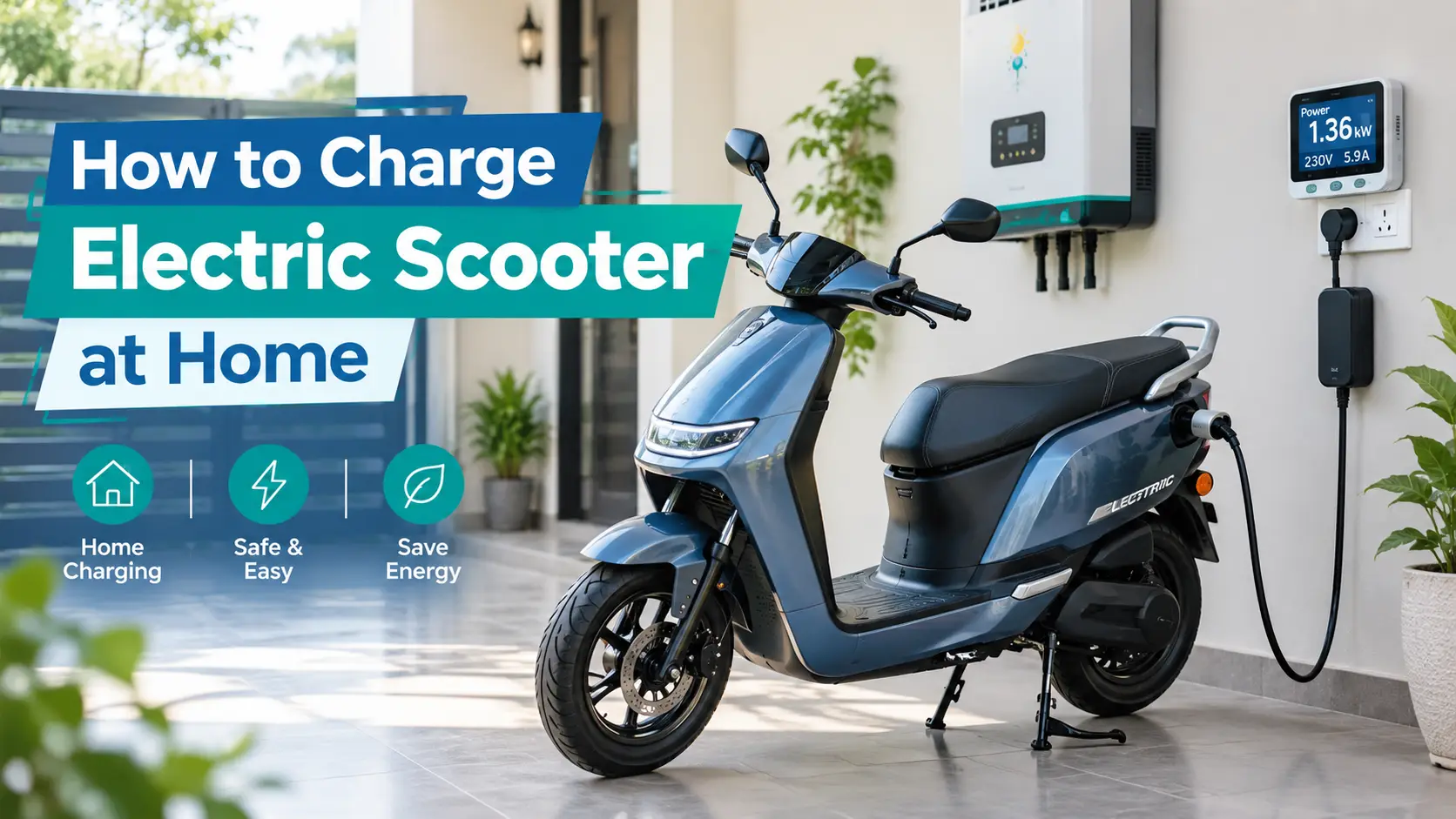
TL;DR: Charging an electric scooter at home in Pakistan typically costs between Rs 18 to Rs 63 per full charge (requiring roughly 1.4 units of electricity including charger loss), translating to about Rs 1.20 to Rs 2.50 per kilometer. This is drastically cheaper than a petrol 70cc motorcycle (~Rs 7.50+/km). To protect your battery and prevent your home electricity bill from jumping into a higher tax slab, use the original charger, avoid peak-slab thresholds, and follow chemistry-specific charging habits (such as the 20–80% rule for Lithium-ion).
You bought an electric scooter. Now you have two questions. How do you charge it at home? And how much will your bill go up?
Charging at home is easy and cheap. A full charge costs far less than a tank of petrol. But a few mistakes can hurt your battery or push up your bill. This guide shows you the right way. Before you ride, also read our guide on electric scooter license and registration in Pakistan so your papers are in order.
How do you charge an electric scooter at home step by step?
Follow these five practical steps to ensure safety and longevity:
- Use the Original Charger: Always use the manufacturer-certified charger matched to your battery voltage. Generic chargers can supply incorrect current and ruin cells.
- Pick a Cool, Ventilated Area: Keep the charger and battery away from direct sunlight, closed cupboards, curtains, and flammable materials.
- Let the Battery Cool Down: Wait 15 to 30 minutes after completing a ride before plugging the scooter in. Charging a hot battery accelerates degradation, particularly in summer.
- Respect Chemistry Guidelines: Do not blindly follow generic charging percentages without identifying whether your battery is Lithium-ion, LFP, or Graphene.
- Monitor Overcharge Protection: Unplug the unit once fully charged unless your setup features a smart auto-cutoff plug or automated timer.
How long does an electric scooter take to charge?
Most scooters take 4 to 8 hours for a full charge. The time depends on battery size and charger current.
A rough formula: charging time (hours) = battery Ah ÷ charger amps, plus about 10–20% extra. Example: a 20Ah battery on a 4A charger takes about 5 to 6 hours.
Range also matters. One dealer says you get about 25 to 30 km per unit. Crown Electric says you typically get around 25 to 30 km per unit of electricity. Real range changes with rider weight, speed and road.
How much does it cost to charge an electric scooter at home in Pakistan?
Most scooters use 1 to 3 units (kWh) for a full charge. One unit on your WAPDA, K-Electric or MEPCO bill equals one kWh.
- Dealer specifications and market insights show a running cost of about Rs 1.20 per km for an electric bike, against Rs 7.50 per km for a standard 70cc petrol bike.
- Real-world costs depend heavily on your household electricity slab and applicable taxes. A fair and realistic range for Pakistani consumers is Rs 1.20 to Rs 2.50 per km.
What is the simple formula to calculate your charging cost?
Use this step-by-step formula with your specific charger and battery specs to find your exact expenses:
- Battery energy (Wh) = Volts × Ah. Example: 60V × 20Ah = 1,200 Wh.
- Convert to units: 1,200 ÷ 1,000 = 1.2 units.
- Add charger loss. Chargers waste about 10–20% of power. So 1.2 units becomes about 1.4 units from the wall.
- Multiply by your unit rate. 1.4 × your rate = cost per full charge.
Check the charger label too. If it says 67.2V and 3A, it draws roughly 200 watts. Charging for 6 hours uses about 1.2 units.
How much does one full charge cost at different unit rates?
The table below outlines estimated costs based on a standard 60V 20Ah battery configuration (drawing ~1.4 units from the wall):
| Your rate per unit | Cost per full charge |
|---|---|
| Rs 13 (protected, 101–200 units) | about Rs 18 |
| Rs 33 (unprotected, 201–300 units) | about Rs 47 |
| Rs 45 (high slab, with taxes) | about Rs 63 |
Disclaimer: Electricity tariffs, fuel price adjustments (FPA), and government taxes in Pakistan fluctuate regularly through NEPRA notifications. The cost calculations below are estimated based on prevailing domestic slab rates and standard 60V 20Ah configurations. Always verify your current utility bill slab before calculating exact operational expenses.
How We Calculated These Numbers
We based these estimates on standard manufacturer battery specifications (60V × 20Ah), factoring in a standard 10% to 20% charger energy loss (averaging ~1.15 multiplier) and prevailing NEPRA domestic slab rates (ranging from Rs 13 to Rs 45 per unit including taxes).
These are theoretical calculated estimates rather than isolated laboratory measurements, so your actual home electricity meter reading may vary slightly depending on your specific charger efficiency, ambient temperature, and household load profile.
Does the 20–80% rule work for every battery in Pakistan?
No. Applying the 20–80% rule universally is a common misconception. Different battery technologies used in Pakistani markets behave differently:
- Lithium-ion (Li-ion / NMC): Best kept between 20% and 80% for daily use.
- LiFePO4 (LFP): Handles full charges better. Charging to 100% is usually fine. One dealer says a LiFePO4 battery can cost Rs 80,000 to 120,000 to replace but lasts 5 to 7 years.
- Graphene batteries: Many “graphene” batteries sold locally are still lead-based with graphene added. They often like full charges and dislike deep discharge. Ask your dealer for your exact battery type.
Always check your scooter manual. The manufacturer’s advice beats general rules.
Can you charge an electric scooter in a flat or apartment?
Yes, if the battery is removable. This is the biggest problem for city riders, and top pages barely cover it.
Here is what to do:
- Buy a removable battery model if you live on an upper floor. Check with the dealer before you pay.
- Carry the battery indoors and charge it near a wall socket in a cool room.
- Keep it away from flammable items. Curtains, sofas, paper and bedding must stay clear.
- Charge on a hard, flat surface. Do not charge on a bed or sofa.
- Charge only when someone is home. Do not charge while the whole family sleeps.
If the battery is fixed, ask your building about a safe ground-floor or parking socket. Do not run a long cord from your flat.
How Do You Protect Your Charger From Load Shedding and Voltage Fluctuations?
Frequent power outages and voltage spikes across Pakistan can damage sensitive charger circuits. Protect your equipment with these measures:
- Use a Quality Voltage Stabilizer: Invest in a dedicated low-capacity voltage stabilizer or surge protector for your charging station.
- Unplug During Outages: Disconnect the charger from the wall socket during active load shedding or thunderstorms to protect against sudden surge currents when power returns.
- Inspect Wall Sockets: Ensure your 3-pin wall socket has tight wiring; loose connections generate extreme heat under continuous high-wattage draws.
If your area has heavy voltage swings, a stabilizer with a UPS-grade rating is a smart buy for the charging spot.
How Does Seasonal Weather Affect Electric Scooter Charging?
- Summer Heat: Heat is the main enemy of any battery. Charge early in the morning or late at night. Park in shade. Do not leave the scooter in the sun and then charge it right away.
- Monsoon & Humidity: Most standard chargers lack waterproof ratings. Never charge outdoors during rainfall, and thoroughly wipe moisture from charging ports before connecting.
- Winter: Cold weather temporarily reduces chemical reaction speed, slightly lowering your single-charge driving range. Bring removable packs indoors to maintain optimal charging temperatures.
Can you charge an electric scooter with solar power?
Yes. If you have solar at home, you can charge with it during the day when the sun is strong. This lowers your grid use.
- Avoid Direct Panel Hookups: Never connect solar panels straight to a scooter charger; fluctuating DC voltages from sunlight variations will fry the internal circuits.
- Instead, plug your charger into a standard AC output socket powered by your hybrid inverter system, ensuring your inverter’s total load capacity accounts for the 200–300W continuous draw of the charger.
FAQs
Can I charge my electric scooter every day?
Yes. Daily charging is normal. For lithium-ion batteries, top up to about 80% on regular days. For lead or graphene types, follow your dealer’s advice.
Can I charge my scooter with a generator?
You can, but only with a stable generator. A weak or unstable generator can send bad voltage. Use a stabilizer.
