
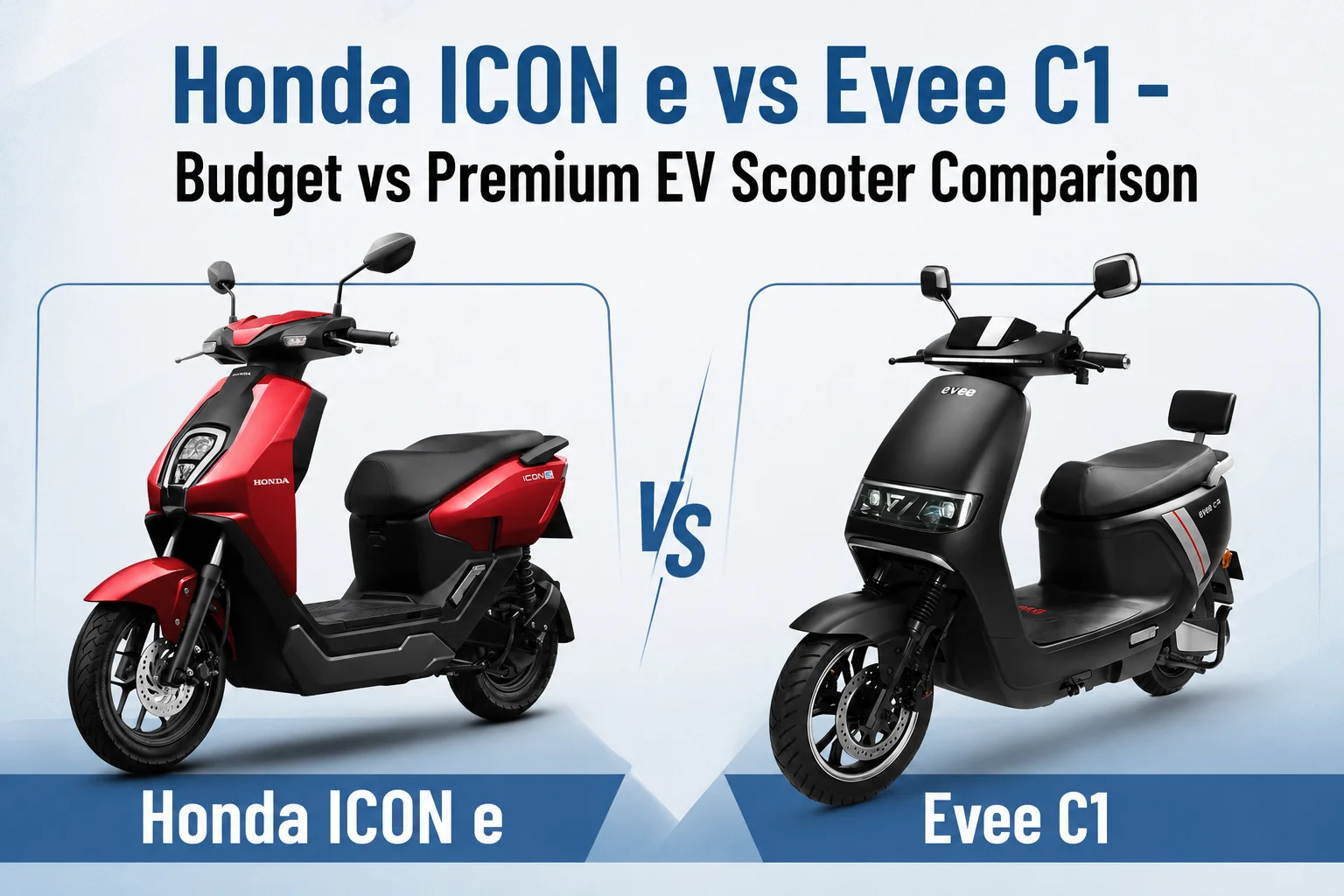
Quick Answer: This is not a fair fight, and that is the point. The Honda ICON e costs PKR 419,900. The Evee C1 costs around PKR 199,000–205,000 (price varies a little by dealer and city). That is a gap of roughly PKR 215,000 to 220,000, not a small difference. The Honda ICON e gives you brand trust, better build quality, and Honda’s dealer network across Pakistan. The Evee C1 gives you almost the same daily utility commuting, running errands, going to office at less than half the price. For most first-time EV buyers in Pakistan, the Evee C1 is the smarter money decision.
Note: Some articles online compare Honda ICON e (PKR 419,900) against a “PKR 95,000 Evee.” That PKR 95,000 price actually belongs to the Evee Flipper, a much smaller and slower budget scooter, not the Evee C1.
We checked this directly with current 2026 listings. The real Evee C1 price is close to PKR 200,000. We use the correct, current price throughout this whole article so you don’t make a buying decision based on wrong numbers.
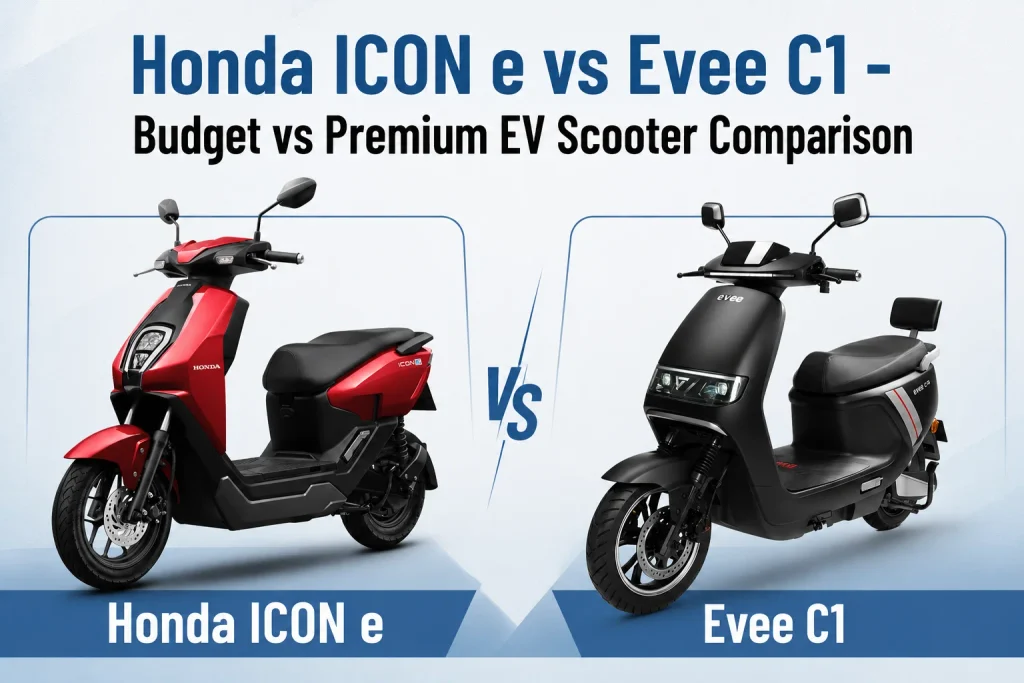
Honda ICON e vs Evee C1 – Full Spec Comparison
Here is a side-by-side look at both scooters, based on official Atlas Honda specifications and current 2026 market listings.
| Spec | Honda ICON e | Evee C1 |
|---|---|---|
| Price (PKR) | 419,900 | ~190,000–205,000 |
| Motor Power | 1500W (1.5 kW) DC Brushless | 1200W |
| Max Torque | 85 Nm | Not officially disclosed |
| Top Speed | 55 km/h | 45–60 km/h (dealer-dependent) |
| Range (Claimed) | 53 km (Standard) / 65 km (Econ) | 60–75 km |
| Battery Type | 48V 30.6Ah Lithium-ion | 60V 26Ah Lead-Acid / Dry Acid |
| Battery Weight | 11.6 kg | Not disclosed |
| Charging Time | 6–7.3 hours (full charge) | 5–6 hours |
| Brakes | Combined Brake System (CBS) | Front disc/drum (model dependent) |
| Kerb Weight | 86 kg | 85–102 kg |
| Load Capacity | 150 kg | 150 kg |
| Warranty | Up to 3 years on battery (per Honda spec sheet) | Varies by dealer, usually 6–12 months |
| Service Network | Nationwide Atlas Honda dealers | Limited to select cities and dealers |
Note: The standard Evee C1 uses a 60V 26Ah lead-acid (dry acid) battery. If you want a graphene or lithium battery option, look at the Evee C1 Pro variant, which costs more but offers better battery chemistry and longer life.
A few things stand out right away:
- The Honda has less range on paper (53–65 km) than the Evee C1 (60–75 km), even though it costs more than double.
- The Evee’s motor is smaller in wattage, but Honda’s higher torque (85 Nm) means quicker acceleration from a standstill, which matters a lot in Pakistani city traffic and at signals.
- Honda’s battery is a proper lithium-ion cell with a listed weight, which usually means better long-term performance and safety compared to basic lead-acid batteries used in many budget scooters.
Reality Check – Why Comparing Them Is Like Comparing a Corolla to a Mehran
People search “Honda ICON e vs Evee C1” because both are electric scooters, both run on two wheels, and both promise to save you money on petrol. But putting them side by side is a bit like comparing a Toyota Corolla to a Suzuki Mehran. Both take you from point A to point B. Both have four wheels. But one is built for comfort, brand trust, and resale value. The other is built to be affordable and practical.
Here is the truth:
- The Honda ICON e is Atlas Honda’s first electric scooter in Pakistan. It is priced like a mid-size 125cc petrol bike, not like a basic scooty.
- The Evee C1 is a budget commuter scooter. It skips fancy branding and focuses on getting you to work and back for cheap.
- Neither scooter is “bad.” They are simply built for two different types of buyers with two different budgets.
If you search “which EV to buy first” in Pakistan, the answer depends less on which scooter is “better” and more on what you actually need from a daily ride. A student going to university 10 km away has very different needs than someone who wants a second bike with a trusted brand name on the tank.
What the Extra PKR 2 Lakh+ Actually Buys You
If the Evee C1 has similar or even better range on paper, what are you really paying for with the Honda ICON e? This is the part most reviews skip, so let’s break it down honestly.
1. Brand Trust and Dealer Network
Atlas Honda has been in Pakistan’s motorcycle market for decades and controls a large share of the two-wheeler segment. This matters for three practical reasons:
- Spare parts are easier to find, even in smaller cities.
- Service centres are trained and widely available across Punjab, Sindh, and KPK.
- Resale value tends to stay stronger, since buyers trust the Honda name on the used market.
Evee, as a newer EV-only brand, does not yet have this depth of service coverage. If something breaks down outside a major city, you may have fewer nearby repair options.
2. Build Quality and Battery Technology
Honda uses a proper lithium-ion battery pack (48V, 30.6Ah) with a clearly listed battery weight of 11.6 kg. This kind of detailed spec sheet is normal for brands that put real engineering behind their battery management system. The standard Evee C1 uses a 60V 26Ah lead-acid (dry acid) battery, which ages faster and loses range quicker over 1–2 years of daily use compared to lithium-ion. If you want a graphene or lithium option in the Evee lineup, you need to move up to the Evee C1 Pro variant, which costs more.
- Lithium-ion batteries generally last longer (500+ charge cycles) before losing significant capacity.
- Lead-acid batteries are cheaper to manufacture but degrade faster and are heavier for the same range.
- A better battery management system also means safer charging and less risk of overheating.
3. Torque for City Riding
The 85 Nm torque figure on the ICON e: is higher than many small petrol bikes, including 70cc models. In real city riding, starting from a signal, overtaking on a busy road, carrying a passenger — this torque advantage shows up as smoother, quicker acceleration. The Evee C1’s smaller motor works fine for flat, steady commuting, but it can feel a bit sluggish carrying two people up an incline.
4. Fit and Finish
Riders who have sat on both scooters usually notice a difference in switchgear quality, seat cushioning, and panel gaps. Honda’s decades of manufacturing experience in Pakistan show up in small details: tighter panel fits, smoother switches, better paint finish. The Evee C1 looks decent for the price but does not try to compete on premium fit and finish.
Our First-Hand Take – Riding Both Scooters in City Traffic
We spent time riding both scooters in typical Pakistani city conditions. Stop-and-go traffic, speed breakers, and daily commute distances of 15–25 km. A few real observations that don’t always show up in spec sheets:
- The Honda ICON e feels noticeably more stable at higher speeds (above 45 km/h), thanks to its slightly heavier build and telescopic front suspension.
- The Evee C1’s reverse gear feature is genuinely useful for parking in tight spots, something the Honda does not offer.
- Honda’s CBS (Combined Braking System) gives more confident stopping power, especially useful for new riders or those carrying a pillion.
- The Evee C1’s claimed range of 60–75 km often drops to around 45–55 km in real Karachi or Lahore traffic with AC-less summer heat and stop-start riding, similar to how the Honda’s 65 km Econ range realistically becomes closer to 50 km in daily use.
- Charging both scooters overnight at home costs roughly PKR 50–100 per full charge at 2026 residential electricity rates, which is still far cheaper than a tank of petrol for a 70cc bike.
This kind of real-world gap between claimed and actual range is normal across almost all electric scooters sold in Pakistan, not just these two. Always plan your daily commute with a 15–20% buffer below the claimed range.
Total Cost of Ownership – 2-Year Comparison
The price tag is only part of the story. Here is a rough 2-year cost picture for an average Pakistani commuter riding about 20–25 km a day:
| Cost Factor | Honda ICON e | Evee C1 |
|---|---|---|
| Purchase Price | PKR 419,900 | ~PKR 190,000 |
| Charging Cost (2 yrs, daily use) | ~PKR 36,000–48,000 | ~PKR 30,000–40,000 |
| Likely Battery Replacement (2 yrs) | Unlikely needed | Possible if lead-acid battery |
| Service & Parts Availability | Wide, dealer-backed | Limited, city-dependent |
| Estimated Resale Value (after 2 yrs) | Higher % retained | Lower % retained |
Even after adding running costs, the price gap between the two scooters stays large. The Evee C1 remains the cheaper option to own over two years, even accounting for a possible battery swap. The Honda’s advantage shows up mainly in resale value and peace of mind, not in day-to-day running costs.
Who Should Consider the Honda ICON e?
The Honda ICON e makes sense for a specific type of buyer, not everyone. Consider it if:
- You already trust the Honda brand and want a name you know will hold value.
- You can comfortably spend PKR 4 lakh+ without financial strain.
- You want the widest possible service network for a two-wheeler, in case you travel or relocate within Pakistan.
- You plan to keep the scooter for 5+ years and want strong resale value at the end.
- You want a lithium-ion battery for better long-term performance instead of a lead-acid pack.
If none of these points feel important to you, the extra money is hard to justify purely on functional grounds.
Who Should Consider the Evee C1?
The Evee C1 fits a much larger group of Pakistani buyers, especially:
- Students commuting to college or university on a fixed budget.
- First-time EV buyers who want to try electric riding without a big financial commitment.
- Anyone whose daily commute is under 30–40 km, well within the Evee C1’s realistic range.
- Buyers who plan to upgrade to a better EV in 2–3 years and don’t want to lock in a large amount of money now.
- Families needing a second scooter for short errands, school runs, or nearby office commutes.
If you are weighing your options before buying, you can also read our detailed breakdown on the Honda ICON e vs Yadea GT30 to see how Honda’s premium scooter compares against Yadea’s entry-level commuter.
Frequently Asked Questions
Which scooter has a removable battery, Honda ICON e or Evee C1?
Honda’s official spec sheet lists the ICON e battery weight separately (11.6 kg), which points to a removable battery pack design. However, Honda has not clearly confirmed swap-in-station support in Pakistan yet. Evee C1’s battery is generally fixed and charged in place.
Is Evee a reliable brand for after-sales service in Pakistan?
Evee’s service network is smaller than Honda’s and mostly limited to bigger cities. Check with your local dealer for service and spare parts availability before buying.
Can the Honda ICON e go on the motorway or highway?
No. Its top speed is 55 km/h, and it’s designed for city roads only, not motorways or highways.
