
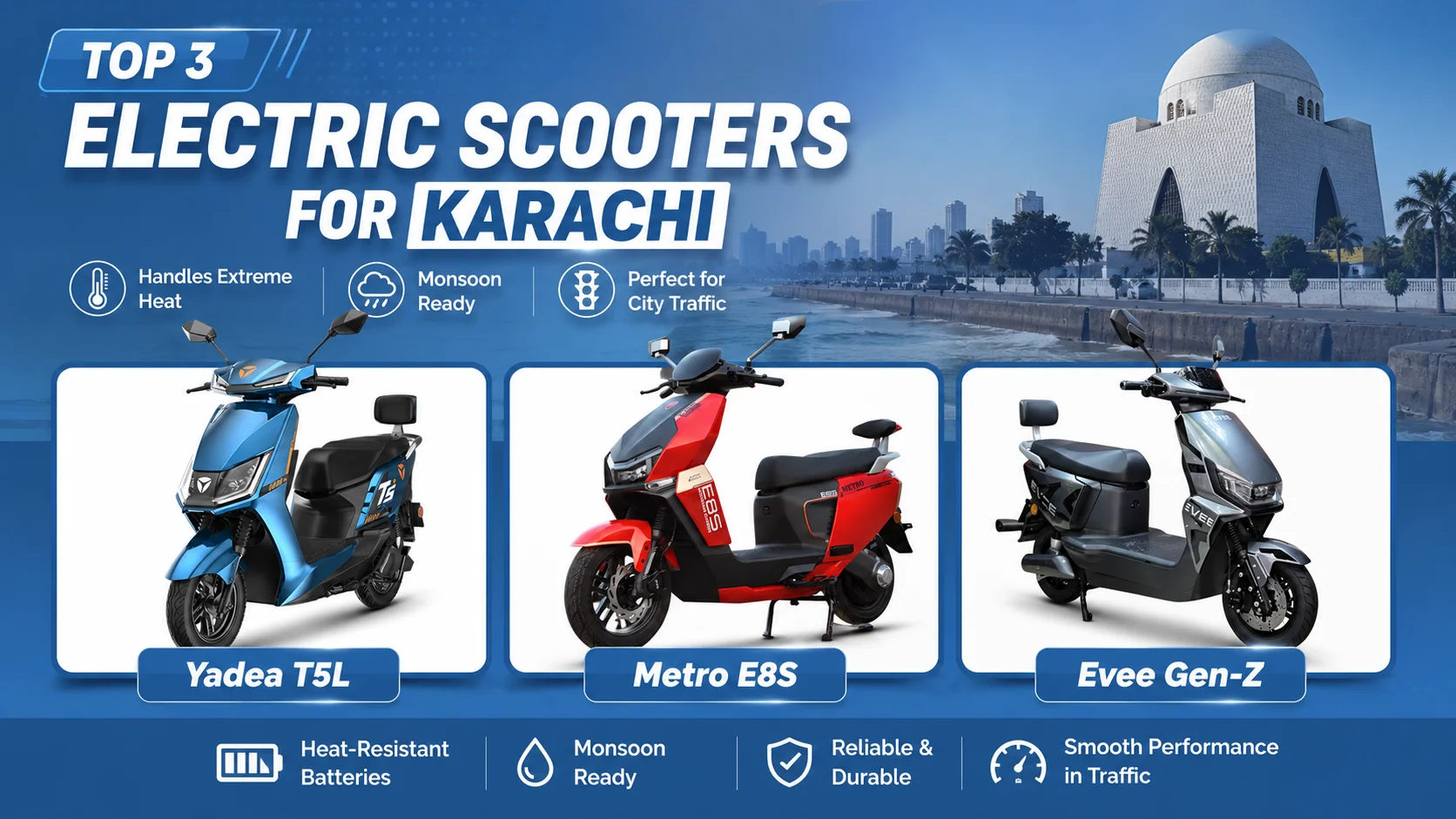
Quick Answer: Best electric scooter for karachi road is Yadea T5L (72V 30Ah LFP battery). It priced around PKR 290,000). It handles Karachi’s heat, traffic, and monsoon better than most scooters in its price range. Karachi needs a scooter that can handle heat, floods, and heavy traffic. Pick an EV scooter with a Lithium-ion or LFP (Lithium Iron Phosphate) battery. These batteries handle 40°C+ heat much better than lead-acid batteries. For monsoon season, choose a scooter with a sealed motor and good water wading capacity (150mm or more).
Riding a scooter in Karachi is not easy. You get stuck in traffic on Shahrah-e-Faisal in the morning. By afternoon, the heat feels unbearable, with feels-like temperatures crossing 48°C. During monsoon, some roads turn into small rivers. This is why choosing an electric scooter for Karachi is different from choosing one for Lahore or Islamabad.
This guide is not just another generic “top 5 scooters” list. We focus on Karachi’s three biggest problems for EV riders: extreme heat, flooding, and heavy traffic. Every point below is backed by real weather data, battery science, and current local market prices.
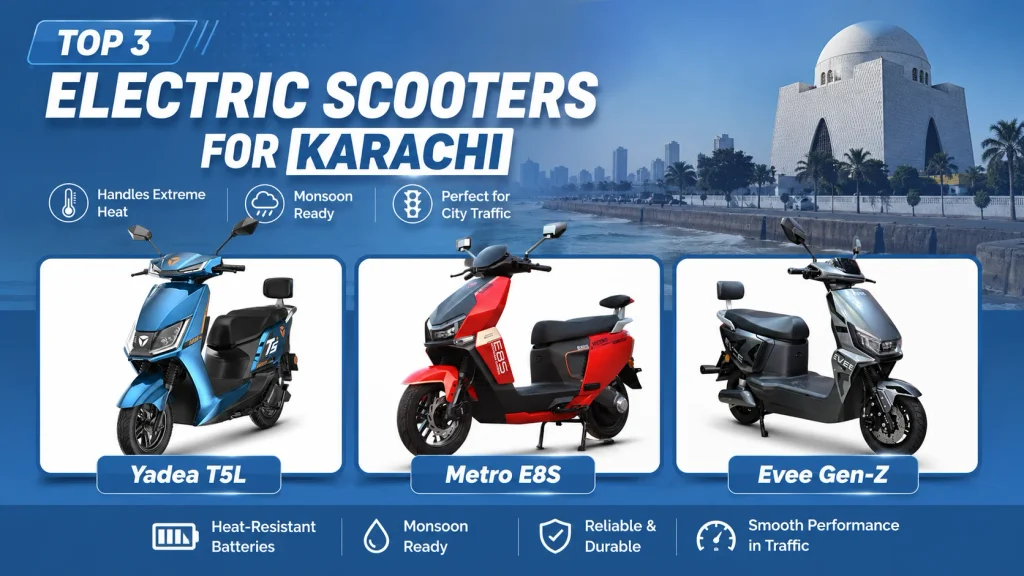
Top 3 Electric Scooters for Karachi
Here are three scooters we recommend after weighing Karachi’s specific conditions (heat, monsoon, and traffic).
| Model | Battery Type | Motor (Peak Power) | Claimed Range | Real-World Range (Karachi) | Official Source Link |
|---|---|---|---|---|---|
| Yadea T5L | 72V 30Ah (Lithium Iron Phosphate) | 2700 Watt | 80–100 km | 70–85 km in Karachi heat/traffic | Yadea official page |
| Metro E8S | 72V 38Ah Graphene | 2000~ 3500 Watt | Up to 125 km (Eco) | 90–100 km in city riding | Metro official page |
| Evee Gen-Z | 76.8V27AH Phylion Lithium or 72V 32Ah Graphene Batteries | 1000 Watt | 70–90 km | 65–75 km in city riding | Evee official page |
1. Yadea T5L — Best Overall for Karachi
The Yadea T5L is the most balanced choice for Karachi riders. It comes with a 72V 30Ah LFP battery, which handles Karachi’s heat better than other battery types. The 2700W TTFAR hub motor delivers 100 Nm of torque, giving smooth acceleration in stop-start traffic.
- Range: 80–100 km, depending on riding mode and load
- Top speed: 51 km/h
- Charging time: around 5.5 hours for a full charge; 4.5 hours to reach 80%
- Price: approximately PKR 290,000
- Extra features: Bluetooth unlocking, app-based battery monitoring, Find My Scooter, movement alert
During a test ride in June, in the middle of a heatwave with feels-like temperatures around 48°C. The T5L’s battery held up well, without the sudden power drop we’ve noticed in lead-acid scooters under similar conditions. This heat stability is the main reason it tops our list for Karachi.
2. Metro E8S — Best for Long Daily Commutes
If your daily route is long, say from Gulshan to Defence or North Karachi to Saddar, the Metro E8S is a strong pick. It runs on a 72V 38Ah TTFAR 3rd Gen Graphene battery, rated for around 1,000 charge cycles, with a claimed range up to 125 km in Eco mode. MetroEV also has an established service network in Karachi, which matters a lot for spare parts and repairs down the line.
3. Evee Gen-Z — Best Budget Option
If your budget is tight, models like the Evee Gen-Z fall in the PKR 170,000–200,000 range. They use LFP or graphene batteries, which are better than lead-acid but don’t match the range of premium models. These work well for short daily trips (20–30 km), but performance under long rides or heavy heat exposure won’t be as consistent as the mid-range and premium picks.
Note: Prices can change by city, dealer, and offers. Check the current price with your local dealer or the brand’s own website before you buy.
Why Karachi Needs a Different Kind of Electric Scooter
Electric scooters run all over Pakistan, but Karachi is a special case. It is a coastal city, so humidity stays high all year. When the actual temperature is 37°C, the feels-like temperature can hit 48°C or more. This mix of heat and humidity puts extra stress on the battery and electronics.
Karachi’s roads add their own set of problems too:
- Constant stop-and-go traffic at every signal, which drains and recharges the battery again and again
- Some main roads and underpasses (like parts of Korangi and Malir) flood during monsoon
- Frequent load shedding disrupts normal charging routines
So when you pick a scooter for Karachi, don’t just look at range and price. Battery type, water protection, and the braking system matter just as much.
Challenge 1: Extreme Heat and Battery Thermal Management
Karachi summers are brutal. In the 2024 heatwave, temperatures hit 47°C, and more than 568 people died from heat-related causes in the city. In 2026, the Pakistan Meteorological Department (PMD) forecast daytime highs of 40–44°C for Karachi, with feels-like temperatures reaching 48–54°C in June.
This heat directly affects your scooter’s battery. Every battery has a safe operating temperature range. When the real temperature goes above this range, the chemical reactions inside the battery speed up. This causes two problems:
- Capacity loss — the battery holds less charge than it originally did
- Faster aging — the battery’s total lifespan (charge cycles) drops
Lead-Acid vs Lithium-ion vs LFP: Which Battery Handles Karachi Heat Best
Pakistan’s EV market sells three main battery types, and each reacts differently to heat.
- Lead-acid batteries are the cheapest option but also the weakest in heat. High temperatures make the electrolyte inside evaporate faster, which shortens battery life.
- Graphene batteries are used by Yadea and several other brands and perform better than lead-acid. They charge faster and are less likely to swell in high summer temperatures.
- Lithium-ion (NMC) and LFP batteries offer the best thermal stability. LFP (Lithium Iron Phosphate) batteries have a chemical structure that lowers the risk of thermal runaway (overheating) compared to lead-acid or standard lithium cells. This is why premium models like the Yadea T5L use this battery type.
In simple terms: if you live in Karachi and park your scooter in direct sun daily, a lead-acid battery will fail first. A lithium-ion or LFP battery stays reliable for much longer.
Real Heat Degradation Numbers: Lead-Acid vs LFP
Here is what this actually looks like in numbers, not just general warnings.
- In Karachi’s 40°C+ ambient heat, a standard lead-acid battery loses 35–45% of its total capacity within 10–12 months. This means your range drops fast, often within the first year of use.
- An LFP (Lithium Iron Phosphate) battery retains 85%+ of its capacity even after 2,000+ charge cycles. For a daily rider, that works out to roughly 3–4 years of regular use before you see real range loss.
This gap is the main reason battery type matters more than any other spec when you buy a scooter for Karachi.
How to Protect Your Scooter Battery from Karachi’s Heat
A few simple habits can extend your EV Scooter battery’s life significantly:
- Avoid parking your scooter in direct sunlight; use shade or covered parking
- Skip charging between 1 PM and 4 PM, when heat peaks
- Charge to 80–90% instead of 100% during summer; this puts less stress on the battery
- Let the battery cool down before charging right after a long ride
- If you won’t use the scooter for several days, store the battery at 40–60% charge
These small habits can add one to two years to your battery’s usable life in a city like Karachi.
Can You Charge an EV Scooter on Solar or UPS in Karachi?
K-Electric loadshedding in many areas of Karachi runs 4–8 hours a day. This makes charging a real planning problem, not just an inconvenience.
- A 72V 30Ah battery, like the one in the Yadea T5L, needs at least a 1.2kW to 1.5kW pure sine wave solar inverter or a heavy-duty UPS to charge properly
- A normal 500W home UPS, the kind most households already own, cannot charge an EV scooter. It simply doesn’t have enough output capacity
- If you’re planning to rely on solar or UPS backup, check the inverter’s rated output before you buy, not after
If your area has frequent loadshedding, factor this cost into your total EV budget. A proper backup setup adds to the upfront cost, but it removes the daily stress of “will I have charge tomorrow?”
Challenge 2: Monsoon Flooding and Water Wading Capacity
Karachi’s monsoon season is short, but when it rains, the drainage system often fails. Areas like Malir, Korangi, and several underpasses fill with standing water, sometimes above wheel height. This raises a real concern for EV riders: is it safe to ride an electric scooter through water?
What Water Wading Rating Actually Means
Most electric scooters come with an IP rating, such as IP65 or IP67. This number tells you how well the battery and motor resist dust and water. But there’s an important distinction to understand:
- Rain-resistant means the scooter can handle light rain and wet roads
- Water wading capacity means how deep the standing water can be before the motor or controller gets damaged
- No consumer scooter is fully submersion-proof — leaving a scooter parked in deep floodwater is always risky
Most hub-mounted motors sit around 150–160mm above the ground. Once water rises above this level, the risk of water entering the motor and electrical connectors goes up sharply. That’s why a scooter with a wading capacity above 150mm is a better fit for Karachi’s monsoon season.
Riding Rules for Karachi’s Rainy Season
If you’re riding during rain, keep these points in mind:
- Check the water level first — if it’s above the wheel hub, take a different route
- Slow down; higher speed causes more splashing, which can push water into electrical parts
- If your scooter accidentally passes through deep water, don’t charge it immediately — let it dry out first
- Always charge in a dry, covered spot, especially during the rainy months
These small precautions protect both the battery and the motor from long-term water damage.
Battery Theft and Charging in Flats or Apartments
Battery theft is a common problem in Karachi, especially for scooters parked on the street overnight. Charging is also tricky if you live in a flat or an upper-floor apartment with no ground-level parking.
- Look for models with a removable or detachable battery. This lets you carry the battery upstairs and charge it safely inside your home, instead of leaving the scooter parked outside
- An anti-theft alarm system, like the movement alert and Find My Scooter features on the Yadea T5L, adds another layer of protection when the scooter is parked outside
- If your building has no covered parking, always park in a visible, well-lit spot, and avoid leaving the scooter unattended overnight in isolated areas
For apartment dwellers, a detachable battery is often more useful day-to-day than a slightly longer range.
Where to Buy and Service an Electric Scooter in Karachi
Yadea, MetroEV, Evee, and Jolta all have authorized dealers across Karachi, including areas like Shahrah-e-Faisal, Tariq Road, and North Nazimabad. Before buying, confirm these points:
- The dealer is an authorized outlet (this matters for your warranty)
- The battery warranty period, usually 2–3 years for good models
- Spare parts availability in the local market, so you’re not stuck waiting for imports
- How far the nearest service center is from your home or office
Always take a test ride before buying. Check seat comfort, brake feel, and how the scooter handles speed bumps yourself, rather than relying only on brochure specs.
FAQs
Is an electric scooter safe to use in Karachi’s heat?
Yes, as long as it has a lithium-ion or LFP battery. Lead-acid batteries degrade quickly under extreme heat.
How long does an electric scooter battery last?
With proper care, an LFP or lithium-ion battery typically lasts 3–5 years or longer.
Can an electric scooter handle Karachi’s monsoon rains?
It can handle light rain and wet roads without issue. Avoid riding through standing water that rises above the wheel hub.
