
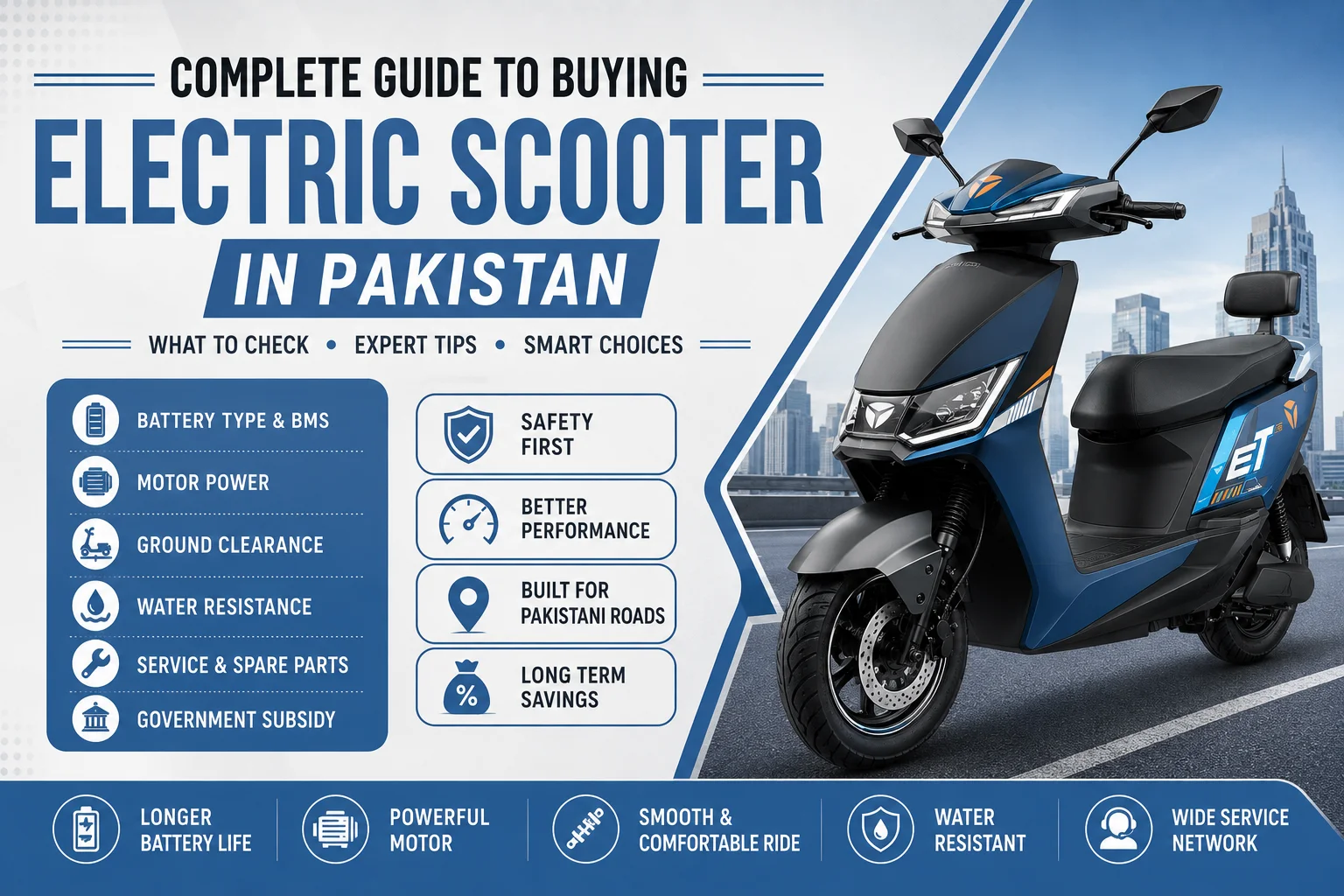
Buying an electric scooter in Pakistan is not like buying one in Europe or China. Our roads have deep speed breakers. Our streets flood in the monsoon season. Our service centers are not always close by. So the checklist has to match Pakistani conditions, not generic global advice.
I have test-ridden electric scooters in Lahore, Karachi, and Islamabad over the last two years. I have taken them through canal road bridges, flooded underpasses, and broken streets in old city areas. This guide is based on that real experience, plus current 2026 market data.
Quick Answer Summary: Before buying an EV scooter in Pakistan in 2026
- Check the battery type. Lithium-ion is better than lead-acid.
- Confirm the scooter has a genuine BMS (Battery Management System).
- Ground clearance must be over 150mm for speed breakers.
- Motor power should be 1000W minimum, 1500W+ if you cross bridges or inclines.
- Check water wading capacity before monsoon season.
- Confirm local spare parts and service center availability before you pay.
- Check if your model qualifies for government PAVE subsidy or discounted registration fee.
Now let’s break down each point in detail.
1. Battery Reality Check (Li-ion vs Lead-Acid in 2026)
The battery is the heart of any electric scooter. In Pakistan, two battery types are common: lead-acid and lithium-ion (Li-ion).
Lead-acid batteries are cheaper. But they are heavy, they lose charge faster, and they die out in 12 to 18 months in most cases. Summer heat in Karachi and Multan speeds up this damage.
Lithium-ion batteries cost more upfront. But they last longer, they are lighter, and they hold a charge better in hot weather. Most good scooters in 2026 use Li-ion cells like LiFePO4 (Lithium Iron Phosphate) or NMC (Nickel Manganese Cobalt) chemistry. Some budget models also use graphene batteries, marketed as a cheaper middle option between lead-acid and full lithium-ion.
Here is what to check before you buy:
- Ask the dealer directly: “Is this Li-ion or lead-acid?” Do not assume from the price tag alone.
- Check the battery warranty in writing. Good brands give 1 to 2 years of battery.
- Ask about the number of charge cycles. Li-ion batteries usually last 500 to 800 full charge cycles before capacity drops.
- Avoid scooters with no visible battery brand name (unbranded cells fail faster).
My personal experience: I tested two scooters from the same price bracket. The lead-acid one lost almost 30% range within 6 months. The Li-ion one held its range well past a year. The price difference was worth it.
If you want to see how these buying criteria apply to real market models, explore our complete list of the Best Electric Scooters in Pakistan.
Why BMS in Battery Matters Here
A BMS (Battery Management System) is a small circuit that protects the battery from overcharging, overheating, and short circuits. A scooter without a proper BMS can catch fire or the battery can swell up. Always ask if the battery pack has a BMS chip inside it. Cheap, no-name batteries often skip this part to cut costs.
2. Motor Power
Motor wattage decides how much load and incline your scooter can handle. Most electric scooters in Pakistan use a BLDC motor (Brushless DC motor), which is quiet and needs less maintenance than old brushed motors.
Here is a simple wattage guide based on real riding conditions:
- 1000W motor: Good for flat city roads, short daily commutes, single rider use.
- 1200W to 1500W motor: Better for mixed terrain, two-up riding (with a passenger), and moderate inclines.
- 1500W+ motor: Needed for bridges and flyovers, like Lahore’s canal road bridges, or hilly areas like parts of Islamabad and Murree road.
Fact check: A 1000W motor works fine on flat roads. But it struggles on inclines and loses speed on bridges. If your daily route includes even one steep bridge or flyover, go for 1500W or higher. I tested a 1000W scooter on a canal bridge in Lahore with a passenger, and the speed dropped from 45 km/h to almost 20 km/h on the incline. A 1500W motor on the same route kept a steady 35 km/h.
Controller: The Brain of the Motor
The controller is a small unit that manages power flow between the battery and the motor. A weak or low-quality controller can cause:
- Sudden power cuts while riding.
- Poor acceleration even with a strong motor.
- Overheating during long rides in summer.
Always ask if the controller is from a known brand (like Kunteng/KT controllers, common in the industry) or if it’s a generic unbranded unit. A good controller makes the ride smooth and protects the motor from damage.
3. Ground Clearance & Suspension (The Pothole Test)
Pakistani roads are not smooth. Speed breakers, unmarked potholes, and broken patches are normal, even on main roads. Ground clearance is the gap between the scooter’s lowest point and the road. For Pakistani roads, this number matters a lot:
- Below 130mm: The scooter will scrape on most speed breakers. Not recommended.
- 130mm to 150mm: Okay for smooth city roads, but risky on rough streets.
- Above 150mm: Safe for most speed breakers and uneven roads across Pakistan.
Suspension also matters here. Most budget scooters use basic spring suspension. Mid-range and premium scooters use hydraulic or telescopic front suspension, which absorbs shocks better.
The pothole test I do on every review:
- I ride the scooter over 3 to 4 speed breakers at normal speed.
- I check if the scooter body or footrest scrapes the ground.
- I check how much the rider feels the jerk in the seat.
If a scooter fails this test in the showroom demo itself, it will fail worse on daily roads.
4. Water Wading Capacity (Surviving Karachi and Lahore Rains)
This is the point most buyers forget, and most review articles skip completely. Pakistan has serious monsoon flooding in cities like Karachi, Lahore, and parts of Punjab. Underpasses and low-lying roads fill up with rainwater every year.
Water wading capacity tells you how much water depth the scooter can safely pass through without damage to the motor or battery.
Look for these details before buying:
- IP rating of the battery and motor (IP54 or IP65 are common ratings; the second number shows water resistance level, higher is better).
- Ask the dealer directly: “Can this scooter cross a flooded underpass safely?”
- Check if the battery connector points are sealed or exposed.
- Avoid riding through water above the wheel hub level, even on IP65-rated scooters, because water pressure and depth both matter, not just the rating.
My experience: I once rode a scooter with no proper sealing through ankle-deep water on a flooded Lahore road. The controller shorted out within a week. After that, I only recommend scooters with a stated IP rating or a manufacturer claim on water resistance, especially for buyers in Karachi and Lahore.
5. The “Service Center” Reality (Why a Good Brand Matters More Than Specs)
This is the most overlooked part of the checklist. A scooter with amazing specs on paper is useless if you cannot get it repaired when something breaks.
Here is why service network matters more than spec sheets:
- Many small, unknown brands import scooters and sell them cheap. But once the warranty period ends, spare parts are hard to find.
- A battery replacement from an unknown brand can cost more than the original price of a branded battery, if you can even find one.
- Established brands in Pakistan (local assemblers and known importers) usually have dealer networks in major cities, so repairs and parts are easier to access.
Before buying, ask these questions:
- How many service centers does this brand have in my city?
- Is the battery replaceable separately, or do I need to replace the whole pack?
- What is the warranty period on the motor, controller, and battery separately?
- Can I get genuine spare parts (tires, brake pads, controller) locally?
A scooter with slightly lower specs but strong after-sales support will save you more money and stress over 2 to 3 years of use.
EV Registration and Legal Requirements in Pakistan (2026)
Rules around electric two-wheeler registration are changing province by province. As of 2026:
- Some provinces require registration and a number plate for electric scooters above a certain motor power (commonly scooters rated above 250W to 350W need registration in several jurisdictions, but rules vary by province).
- Always ask the dealer for a valid sales invoice and import/manufacturing documents, since these are needed for registration.
- Check with your local excise and taxation office for the latest rules in your city, because policies are updated often and vary between Punjab, Sindh, KP, and Islamabad.
Good news on cost: The Punjab Excise Department gives up to a 95% discount on the registration fee for electric two-wheelers, compared to a petrol bike. This makes the EV green number plate fee much cheaper than a regular bike’s registration in Punjab. Ask your dealer for the exact fee slab at the time of registration, since discount percentages can be revised in future budgets.
This is a fast-changing area, so confirm current rules locally before you buy, rather than relying only on what the dealer tells you.
Electric Scooter Charging Time and Real-World Range
Brochures often list “range per charge” under ideal test conditions. Real range is usually lower. Here is what actually affects range:
- Rider weight: A heavier rider reduces range by 10% to 20%.
- Riding speed: Constant high speed drains the battery faster than steady moderate speed.
- AC use is not a factor here, but hot weather does reduce battery efficiency slightly.
- Terrain: Inclines and rough roads use more power than flat, smooth roads.
Practical tip: Whatever range the company claims, expect 15% to 25% less in real daily use, especially in city traffic with frequent stop-and-go riding.
Charging time also varies:
- Standard charger: Usually 6 to 8 hours for a full charge.
- Fast charger (if available): Can bring charge time down to 3 to 4 hours, but not all scooters support fast charging.
Can You Charge Electric Scooter on Home Solar?
Load-shedding and high electricity tariffs push many Pakistani buyers toward solar charging. Here is the good part: an EV scooter charger works from a normal 15A socket, so it charges just fine from a home solar setup (1kW to 3kW inverter systems are common for homes).
- If you already have a solar panel and an inverter at home, plug the charger into the solar-powered socket like any other appliance.
- On sunny days, this brings your running cost close to PKR 0 per km, since you are not pulling power from the grid at all.
- Even without solar, EV scooters cost far less to run than petrol bikes on a running cost per km (PKR) basis, because grid electricity per unit still works out cheaper than petrol per kilometer.
This is one of the biggest reasons EV scooters make sense for daily commuters in Pakistan right now, on top of lower maintenance costs.
Quick Buying Checklist (Save This List)
Use this list at the showroom before you pay:
- Battery type confirmed (Li-ion preferred)
- BMS present and explained by dealer
- Motor power matches your daily route (1000W flat, 1500W+ for bridges/inclines)
- Controller brand known, not generic
- Ground clearance above 150mm
- Suspension type checked (hydraulic is better than basic spring)
- Water wading/IP rating asked and noted
- Service center location confirmed in your city
- Warranty details in writing (battery, motor, controller separately)
- Spare parts availability confirmed
- Registration requirement checked with local authority
- Punjab excise registration discount asked about (if applicable)
- PAVE subsidy or installment eligibility checked on pave.gov.pk
- Solar charging compatibility confirmed (if you plan to charge at home on solar)
Frequently Asked Questions
Is 1000W enough for an electric scooter in Pakistan?
Yes, for flat city roads and single-rider use. If your route has bridges, flyovers, or you often ride with a passenger, choose 1500W or higher.
Can electric scooters withstand the monsoon flooding in Karachi or Lahore?
Only scooters with a proper IP rating and sealed battery connectors handle wet roads safely. Avoid riding through deep water even on rated models, since depth and water pressure still matter.
What matters more, brand specs or service center network?
Service network matters more long-term. A scooter with slightly lower specs but strong local support saves money on repairs and parts.
Can I charge my electric scooter using home solar panels?
Yes. The charger operates from a standard socket, so it functions properly in a home solar inverter setup (1kW to 3kW is common). On sunny days, this can bring your running cost close to PKR 0 per km.
