
TL;DR: Quick Summary
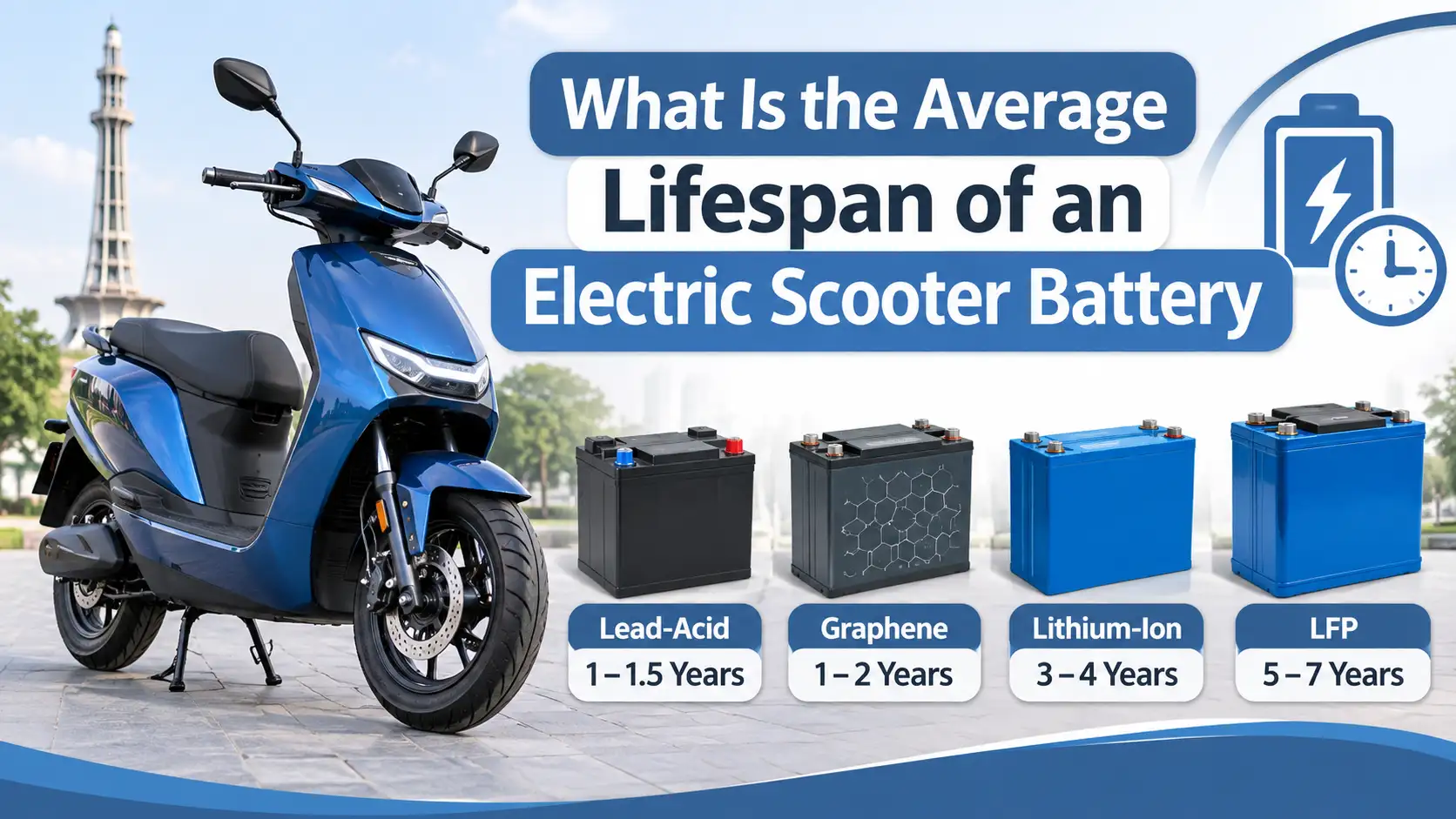
- Lead-acid battery: Lasts about 1 to 1.5 years (200–300 charge cycles).
- Graphene-coated lead-acid battery: Lasts about 1 to 2 years (300–500 cycles at best). Most dealers in Pakistan market this as a “graphene battery”.
- Lithium-ion (Li-ion) battery: Lasts about 3 to 4 years (800–1,000 cycles).
- LFP (LiFePO4) battery: Lasts about 5 to 7 years (2,000–3,500 cycles). (Read our detailed breakdown on What is LFP battery in electric scooter)
- Top 3 Rules for Pakistani Riders: Never drain the battery to 0%, let the scooter cool for 30 minutes before charging during intense summer heat, and use only the original OEM charger.
Switching to an electric scooter looks like an instant financial win because you skip the escalating petrol bills. However, the battery is the most expensive component of your EV. If a budget battery dies in 18 months, those initial savings shrink rapidly.
So, how long does an electric scooter battery actually last? The answer depends on the battery chemistry, your charging habits, and how well it handles local weather conditions. In Pakistan, severe summer heat and voltage fluctuations are the biggest threats to battery longevity.
How Long Does an Electric Scooter Battery Last? (By Battery Type)
Battery life is measured in charge cycles, not only in years. A cycle count tells you how much work the battery can do before it gets weak.
| Battery type | Charge cycles | Typical life (daily use) |
|---|---|---|
| Standard lead-acid | 200–300 | 1 to 1.5 years |
| Graphene-coated lead-acid | 300–500 | 1 to 2 years |
| Lithium-ion (Li-ion) | 800–1,000 | 3 to 4 years |
| LiFePO4 (LFP) | 2,000–3,500 | 5 to 7+ years |
Disclaimer: These figures represent averages under optimal care. In harsh Pakistani weather conditions or with aggressive riding, budget lead-acid packs may degrade in 6 to 12 months.
Why does lithium last longer than lead-acid?
- Lead-acid cells lose capacity quickly when you drain them deeply.
- Lithium cells handle more charge and discharge cycles.
- LFP cells stay stable in heat better than most other lithium cells.
- Lithium packs also have a Battery Management System (BMS) that protects the cells from overcharging and overheating.
What Is a Charge Cycle?
A charge cycle means you use 100% of the battery’s energy. It does not mean one plug-in.
Here are three easy examples:
- You use 100% and charge it back to 100%. That is 1 cycle.
- You use 50%, charge, use another 50%, and charge again. That is also 1 cycle, not 2.
- You use 20% every day and top up each night. You need 5 days to complete 1 cycle.
So plugging in twice a day does not use up two cycles. The battery counts the total energy you use. This is why short top-ups are fine for lithium and LFP batteries.
Quick Calculation: If your battery has 500 cycles and you use one full cycle per day, it lasts about 500 days. That is roughly 1.4 years. If you only use half a cycle per day, it lasts about 2.7 years.
Is a “Graphene” Battery in Pakistan Really Graphene?
Many buyers fall for marketing terms, believing graphene represents a space-age battery breakthrough. The local market tells a different story:
- According to industry updates published via Profit Pakistan Today, the Pakistan Automotive Manufacturers Association (PAMA) said over 90% of electric two-wheelers sold locally use lead-acid batteries with a thin graphene coating.
- PAMA called these claims misleading and asked the government for clear battery labels and minimum warranty rules.
- PakWheels also published a report on this issue. It explains that these batteries are close to normal lead-acid batteries with a small upgrade.
- PAMA also noted that no maker offers more than 24 months of warranty on these batteries.
The graphene layer may help a little with heat and charging. Some brands say it improves conductivity. But the core is still lead-acid. That means:
- It is heavy.
- It loses capacity faster than lithium.
- It hates deep discharge.
- It needs replacement sooner.
What this means for you: A graphene scooter is not a bad buy if the price is low and you plan to replace the battery. But do not expect lithium-level life. Always ask the dealer, “Is this battery lead-acid, lithium-ion, or LFP?”
What Reduces Electric Scooter Battery Life the Most?
Five things shorten battery life. Fix these first.
- Heat. A hot battery ages faster. Many battery experts use a rule of thumb that lead-acid life can fall by half for every 8 to 10°C above room temperature. Multan, Lahore, and Karachi roads often reach 45°C in June and July.
- Deep discharge. Riding until the scooter stops hurts the cells. Lead-acid suffers the most.
- Heavy load. A pillion rider, steep flyovers, and full throttle pull more current. This heats the battery and makes it age faster.
- Bad charger. Cheap local chargers can send the wrong voltage and damage the BMS or cells.
- Low-quality cells. A cheap pack from an unknown brand can fail in months. Pakistani EV owners have shared this in media reports about the repair market.
How Can You Understand Your Electric Scooter Battery Is Dying?
Watch out for these warning indicators:
- Sudden Range Drop: A scooter that previously delivered 70 km per charge now struggles to cross 35 km.
- Voltage Sag Under Load: The dashboard battery percentage drops sharply from 70% to 30% when you accelerate or climb a slope, then bounces back when you stop.
- Physical Swelling: The battery casing looks bloated or deformed. (Critical safety hazard: stop using immediately and visit a service center).
- Abnormal Charging Times: The charger turns green within an hour (indicating reduced capacity) or never turns green.
- Excessive Heat: The charger or battery pack becomes dangerously hot to the touch during charging.
Expert note: A fast “green light” often means the battery has lost capacity. A small battery fills quickly. A charger that never turns green can point to a charger fault or a damaged cell group.
How Can You Extend Your Electric Scooter’s Battery Life? (5 Proven Tips)
1. Follow the 20–80% Charging Rule
Never let the scooter hit 0%. Deep discharge damages the cells. For daily rides, keep the battery between 20% and 80% if you have a lithium or LFP pack.
- Charge before the battery falls below 20%.
- Unplug at 80% to 90% on normal days.
- For lead-acid or graphene packs, recharge the same day. Do not leave them half-empty for days.
- For LFP packs, a full 100% charge once every few weeks helps the BMS balance the cells.
2. Protect the Battery from Extreme Heat
Heat destroys batteries faster than anything else in Pakistan.
- Do not plug in right after a long ride in the sun. Wait at least 30 minutes.
- Park in the shade. A covered parking spot helps a lot.
- Charge in a ventilated room, not inside a closed store.
- In June and July, charge late in the evening or early morning when it is cooler.
3. Stop Overnight Charging with Basic Chargers
Most budget scooters come with a simple charger. A good charger switches to a trickle or stops at full charge. A bad one keeps pushing current.
- Do not leave the scooter plugged in for 10 hours if you do not know the charger has auto cut-off.
- Overcharging causes heat. In lithium packs, extreme heat can lead to thermal runaway, which is a dangerous chain reaction.
- A timer plug is a cheap fix. Set it for the time you need.
- Never charge on a bed, sofa, or near curtains.
4. Always Use the Original OEM Charger
The charger must match the battery voltage and chemistry. A lead-acid charger can harm a lithium battery. A cheap generic charger can also give poor voltage control.
- Buy a replacement only from the brand’s service center.
- Check the voltage and amp rating on the label.
- Replace a charger that gets very hot or smells strange.
5. Store the Battery at About 50% for Long Breaks
If you travel or keep the scooter idle for weeks:
- Charge the battery to about 50%.
- Turn off the main circuit breaker (MCB) or disconnect the battery if the manual allows it.
- Store the scooter in a cool, dry place.
- Check it once a month and top up if it falls below 30%.
- Lead-acid batteries need extra care. Do not leave them fully discharged because they can sulfate and lose capacity permanently.
How Does Pakistan’s Summer Heat Affect Electric Scooter Battery Life?
Heat is the biggest local factor. Here is what happens and what you can do.
- What happens: At 40–45°C, chemical reactions inside the battery speed up. The battery ages faster, loses range, and can swell.
- Lead-acid: Heat dries out the electrolyte and speeds up plate damage.
- Lithium: Heat raises internal resistance. LFP handles heat better than most Li-ion types, but it is not heat-proof.
- Ride smart: Use Eco-mode on long summer rides to lower current draw.
- Avoid stop-and-go with a pillion rider at noon if you can.
- Check the battery box: Make sure no dust or plastic cover blocks airflow.
- Winter: Cold weather lowers range for a while, but it hurts the battery less than heat. Expect 10–20% less range on very cold mornings.
What Does BMS Do in an Electric Scooter Battery?
The Battery Management System (BMS) is a small circuit board. It guards the battery. A good BMS:
- Stops charging at the right voltage.
- Cuts off power when the battery is too low.
- Balances the cells so one cell does not age faster than the others.
- Shuts down the pack if it gets too hot or too much current flows.
Lithium and LFP scooters rely on the BMS. Lead-acid packs often have a very simple system or none at all. That is another reason lead-acid wears out faster when the owner makes small mistakes.
What Should You Check Before Buying? (Battery Warranty Guide)
Warranty tells you how much the brand trusts its own battery.
- Ask for the battery warranty in months and kilometres.
- Ask what counts as a failure. Some brands cover only a drop below a set capacity.
- Get the terms in writing. Yadea’s own pages list different terms for the T5L (4 years or 50,000 km on one page, 36 months or 40,000 km on another). Confirm the current terms with your dealer.
- Ask where the nearest service center is in your city.
- Ask if the battery is lead-acid, lithium-ion, or LFP.
Frequently Asked Questions (FAQs)
Does Eco-mode protect the battery?
Yes. Eco-mode limits the current the controller draws. This lowers heat and stress on the cells during acceleration.
Can I ride while the scooter is charging?
No. Do not ride or keep the scooter on while it charges. This can overload the charger and the BMS.
