
TL;DR (Quick Summary):
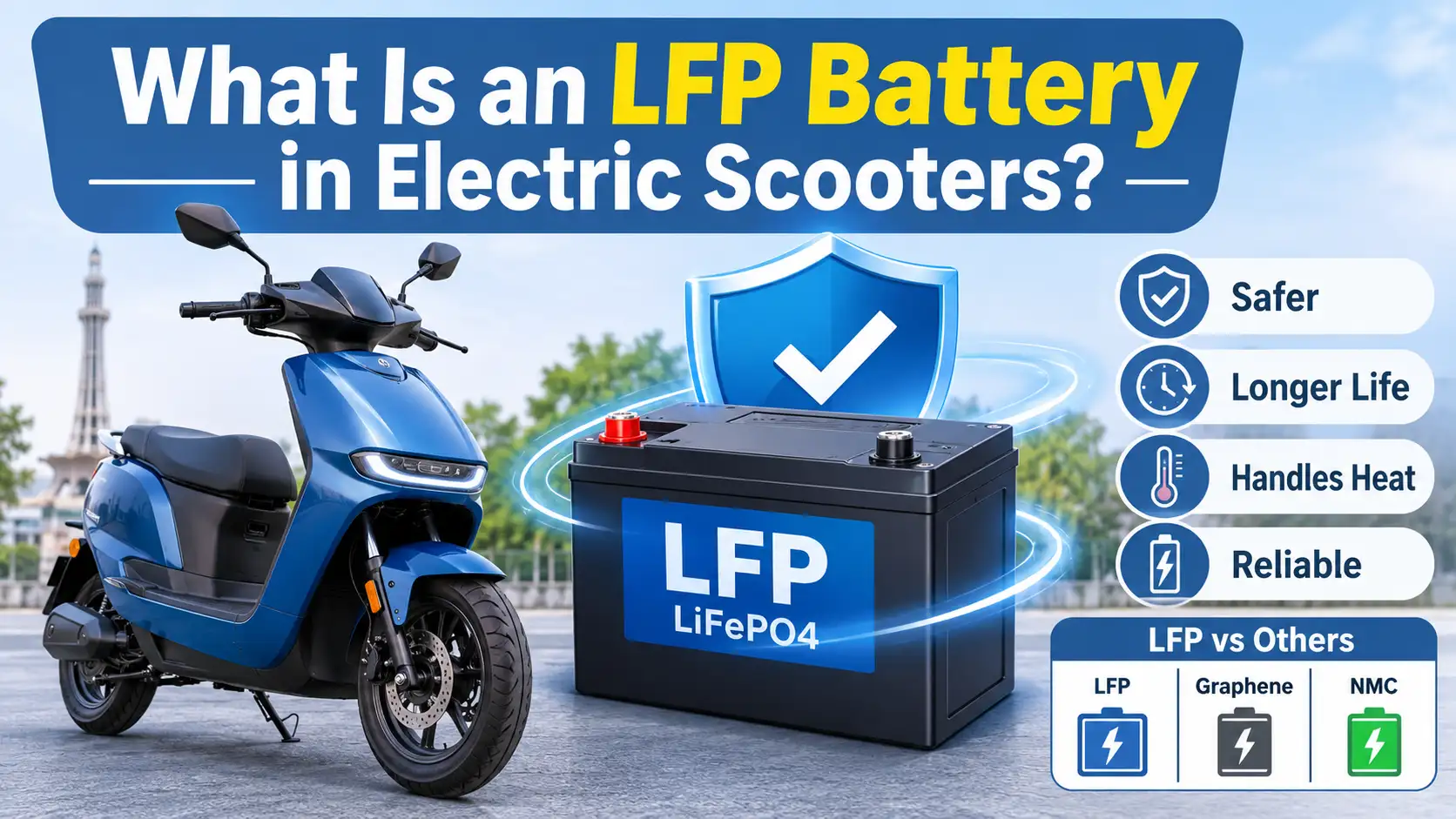
An LFP battery is a Lithium Iron Phosphate (LiFePO4) battery. It is a type of lithium-ion battery that uses iron and phosphate instead of cobalt. This makes it more stable, safer in heat, and longer lasting than the standard lithium-ion (NMC) battery in many phones and laptops. It also lasts much longer than the graphene (advanced lead-acid) batteries sold on most budget scooters in Pakistan.
- Lifespan: Good LFP cells give around 2,000 to 4,000 charge cycles. That is often 6 to 10 years of normal use.
- Safety: LFP is much harder to push into thermal runaway (a battery fire). The risk is lower, not zero.
- Heat: LFP handles Pakistan’s hot summers better than NMC and lead-acid.
- Pakistani LFP scooters in 2026: Yadea T5L, MS Jaguar Bolt and M1 (LFP option), and Revoo A11 LFP and A12 LFP.
What Is the Difference Between LFP, Graphene, and Standard Lithium-Ion (NMC) Batteries?
Many buyers mix these three batteries. Here is a simple comparison.
| Feature | LFP (LiFePO4) | Graphene (advanced lead-acid) | Standard Lithium-Ion (NMC) |
|---|---|---|---|
| Fire safety | Very stable, low fire risk | No thermal runaway, but can leak acid and gas | Higher fire risk if damaged or overheated |
| Cycle life | About 2,000 to 4,000 | About 300 to 800 (brand claims vary) | About 1,000 to 2,000 |
| Heat tolerance | Good | Weak, ages faster in heat | Weak to moderate |
| Weight | Medium | Heavy | Lightest |
| Cobalt | No | No | Yes |
| Typical charge time in Pakistan | 3 to 6 hours | About 7 hours |
Note: In Pakistan, most “graphene” scooter batteries are actually heavy lead-acid batteries enhanced with a graphene additive, they are not true lithium packs. This makes LFP a genuine technological upgrade rather than just marketing jargon. Furthermore, Revoo says that its A11 LFP model is over 20% lighter than its graphene counterpart.
How Does an LFP Battery Work?
An LFP battery stores energy in a cathode made of lithium iron phosphate. The molecular bonds here are exceptionally strong and do not readily release oxygen when the cell heats up. Oxygen is the primary catalyst that fuels battery fires.
In contrast, NMC (Nickel Manganese Cobalt) cells break down at lower temperatures, making them more vulnerable under severe stress, short circuits, or heavy overheating. This stability is precisely why major global electric vehicle manufacturers rely heavily on LFP chemistry for standard-range models.
Why Is LFP Safer for Pakistan’s Extreme Summer Heat?
Pakistan’s summer can push road temperatures past 45°C. Heat is the biggest enemy of any battery. It ages the cells faster and raises the risk of failure.
LFP helps in three ways:
- It stays chemically stable at higher temperatures.
- It loses less capacity when stored in hot weather.
- It does not release oxygen easily, so a fire spreads far less.
Does LFP Mean Zero Fire Risk?
No. Be careful with claims that say “zero risk.” LFP is much safer, but a damaged pack, a cheap charger or water damage can still cause problems.
Keep these habits:
- Park your scooter in the shade whenever you can.
- Do not charge right after a long hot ride. Let the pack cool for 20 to 30 minutes.
- Use only the original charger.
- Never charge a pack that is swollen, wet, or damaged.
What About Cold Weather in Northern Pakistan?
An often-overlooked factor in regional guides: LFP cells resist charging when temperatures drop below 0°C. If you live in Murree, Gilgit, Skardu, or the hilly regions of Swat, you should charge your scooter indoors.
Modern Battery Management Systems (BMS) automatically block charging in freezing temperatures to safeguard internal chemistry, though overall operating range will still dip temporarily in sub-zero weather.
What Does “3,000 Charge Cycles” Really Mean?
One cycle equals the energy of one full charge from 0% to 100%. It does not mean one trip. Two charges from 50% to 100% count as one cycle.
Here is the simple math:
- A battery rated for 3,000 cycles, charged fully once a day, lasts about 8 years.
- A battery rated for 2,000 cycles, charged fully once a day, lasts about 5.5 years.
- If you ride 30 km a day on a scooter with an 80 km range, you use about 0.4 cycles a day. On paper, the cells can last far longer than 10 years.
But real life is different. Cells also age with time and heat, even when you do not use them. So do not treat the cycle number as a promise. The battery warranty is a better guide. It shows how much risk the brand accepts.
How Long Is the LFP Battery Warranty in Pakistan?
Here are the warranties listed by the brands in 2026:
- Yadea T5L: 4 years or 50,000 km.
- MS Jaguar (LFP variants): 3 years. Graphene variants get 18 months.
- Revoo A11 LFP and A12 LFP: 36 months on the battery and 24 months on the motor.
Always read the warranty card. Check what it covers, what voids it, and whether it has a km limit.
What Is a BMS and Why Does Every LFP Battery Need One?
BMS stands for Battery Management System. It is a small circuit board inside the battery pack. It acts as the pack’s brain.
A good BMS does these jobs:
- Stops overcharging and deep discharge.
- Balances every cell so they age evenly.
- Cuts power during a short circuit.
- Protects the pack from high or low temperatures.
- Reports charge level to the display.
Pakistan has voltage swings and load-shedding. Power often cuts off and comes back suddenly. A strong BMS protects the pack from these jumps. A weak BMS can ruin an expensive battery.
How Can You Protect Your LFP Battery in Pakistan?
- Use a voltage stabilizer or a good surge-protected socket at home.
- Use the original charger only. Cheap chargers can send the wrong voltage.
- Avoid charging from 0%. Try to plug in between 10% and 20%.
- For daily use, charging to 100% is fine on LFP. Many makers say so. Still, a long stay at 100% in hot weather is not ideal.
- Keep the pack away from direct sun and water.
- If you do not ride for weeks, store the scooter at about 50% charge in a cool place.
How Much Does an LFP Scooter Cost in Pakistan in 2026?
LFP scooters cost more upfront than graphene scooters. Here is what the brands list.
- Yadea T5L: The Yadea Pakistan site lists it at PKR 290,000. Some price sites show PKR 305,000. Dealer prices differ. Before choosing this, read our Yadea T5L review.
- MS Jaguar Bolt: The base Bolt starts at PKR 174,000, and the Bolt is available with an LFP battery option. The LFP version costs more. Ask the dealer for the exact price.
- MS Jaguar M1: It starts at PKR 204,000 and comes with a graphene or LFP choice.
- Revoo A11 LFP: Listed at PKR 205,000 on the Revoo site. A limited offer earlier in 2026 cut it to PKR 199,000.
- Revoo A12 LFP: Listed at PKR 239,000 during that offer.
Price Disclaimer: Electric scooter prices in Pakistan fluctuate frequently due to currency exchange rates, shipping costs, and local dealership policies. The prices mentioned below are based on brand listings and should be treated as a helpful guide rather than a fixed final cost. Always confirm with your dealer before making a purchase.
How Can You Check That a Scooter Really Has an LFP Battery?
Some sellers use the word “lithium” loosely. Do not trust the word alone. Check these points:
- Spec sheet: Look for the words LiFePO4 or LFP and the exact voltage and Ah.
- Battery label: It should show chemistry, voltage, capacity, and a serial number.
- Cell maker: Ask which company makes the cells. Well-known LFP cell makers include CATL, BYD, EVE and Gotion.
- BMS: Ask if it shows charge level and protects against heat and short circuits.
- Water protection: Ask for the IP rating of the battery pack. Monsoon riding and flooded roads are common in Pakistan.
- Warranty: Get it in writing, with the km limit and the service centre address.
- Service network: A great battery is of little use if nobody near you can service it.
What Should You Check on a Test Ride?
- Check the charge display before and after a short ride. Does it drop in a smooth way?
- Feel the battery area after a ride. It should be warm at most, not hot.
- Ask to see the charger and its rating.
- Test the scooter on a slope with a pillion if you carry one.
How Much Does an LFP Battery Replacement Cost in Pakistan?
There is no single fixed price. It depends on the brand, voltage, and Ah rating. LFP packs for 60V to 72V scooters can cost lakhs of rupees, and brands rarely publish fixed replacement prices. Ask your dealer for a written quote before you buy the scooter.
This matters because a replacement can be a major future expense, even with LFP. The longer life of LFP pushes that cost far into the future, and the warranty covers the early years.
Is an LFP Scooter Worth the Extra Money?
It depends on how you ride.
LFP is worth it if:
- You ride 30 to 50 km or more every day.
- You park in the sun or live in a hot city like Multan, Lahore, Karachi or Jacobabad.
- You want to keep the scooter for 5 years or longer.
- You want a longer written battery warranty.
Graphene may be enough if:
- You ride under 15 km a day.
- Your budget is tight.
- You plan to sell the scooter in 2 years.
Think about the total cost of ownership. A graphene battery may need replacement within a few years under daily use. An LFP battery often avoids that. The exact savings depend on the price of the battery you replace, so ask your dealer for the number before you decide.
If you are just starting your research and want to compare different types of power sources available in the local market, check out our guide on the Best electric scooter batteries in Pakistan to see how LFP stacks up against other options.
Frequently Asked Questions
Does LFP weight affect speed?
LFP is heavier than NMC, but lighter than lead-acid and graphene. Speed on these scooters depends mostly on the motor and controller. Weight affects range and handling a little.
Is LFP safe to charge overnight?
With the original charger and a healthy BMS, it is generally safe. Still, charge in a ventilated place away from fuel and clutter. Do not charge a damaged battery.
